11 Description — Screening station (Auto and Button mode)
This chapter describes a screening station for Auto mode or Button mode screening.
11.1 Overview
The screening station consists of a FLIR Exx-EST thermal camera, a clearly defined screening position, and a queueing system.
The thermal camera measures the temperature around the tear duct of the screened person, analyzes the measured temperature,
and displays a screening result.
For improved measurement accuracy, it is important that the screened person is at the correct distance from the camera. The
screening position indicates where the person should stand for the screening.
For an efficient screening flow, a queueing system is needed to guide the visitors into the screening station, to the correct
screening position, and out of the screening station. A backdrop may be needed to prevent background disturbances from reaching
the camera.
11.2 Typical setup
The figures below show a typical screening station setup.
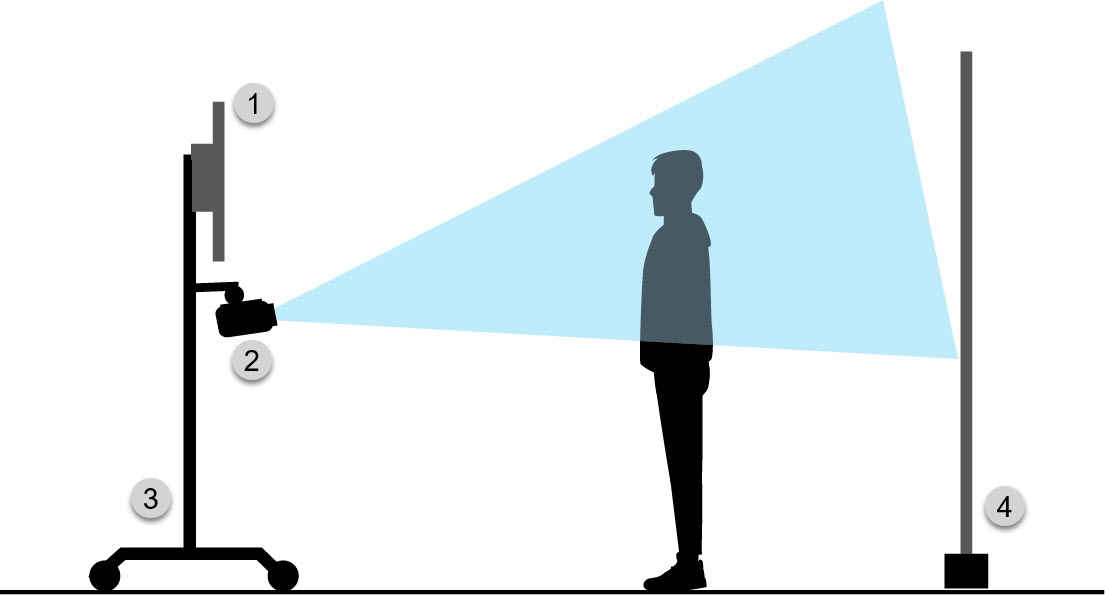
- Visitor display
- Thermal camera
- Stand
- Optional: Backdrop
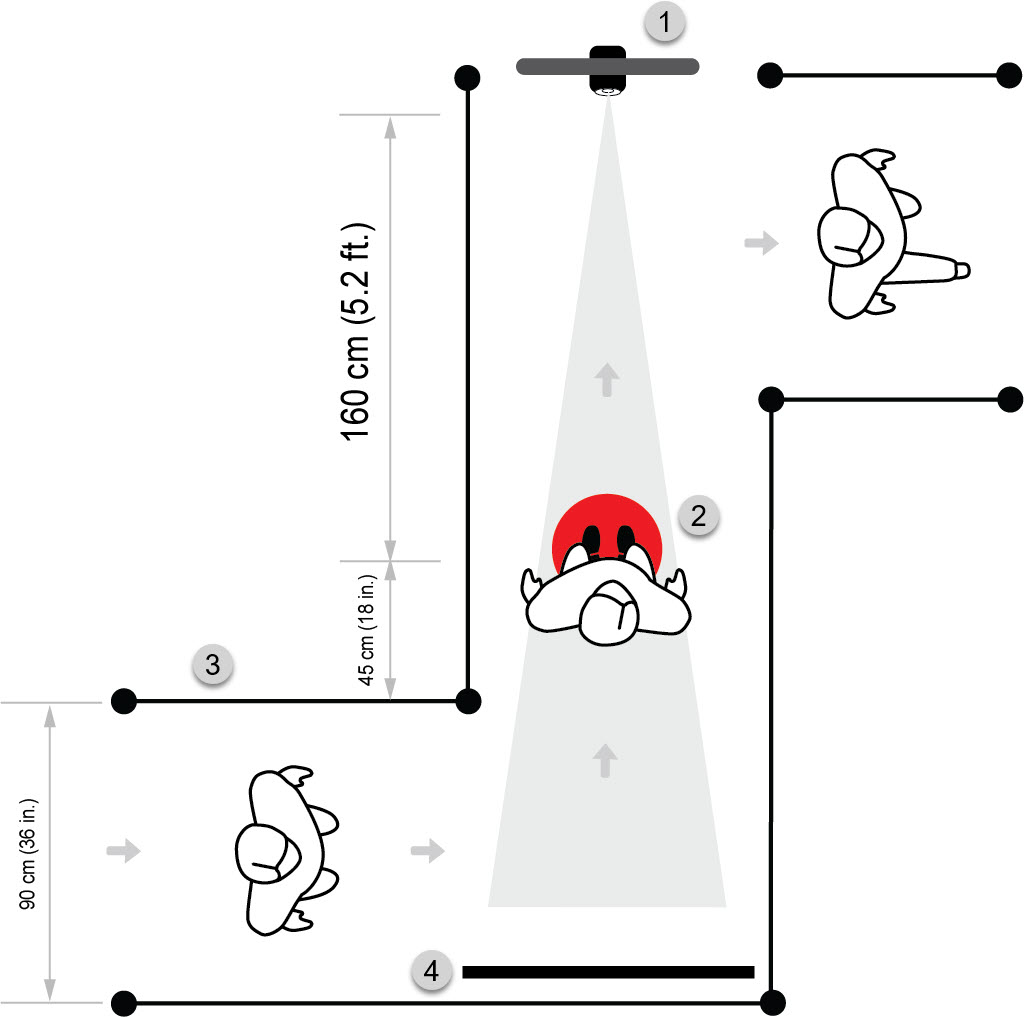
- Stand with thermal camera and display.
-
Screening position.
It is important to clearly mark where the person shall stand for the screening. This is called the screening position. The face of the screened person should be at the center of the screening position.
The screening position shall be perpendicular to the camera, so that the screened person directly faces the camera. The distance from the camera lens to the center of the screening position shall be 160 cm (5.2 ft.).- For accurate temperature measurements, it is important that the thermal camera focus is correct. With a fixed screening position, the focus can be adjusted once and for all during the initiation of the screening (no need to adjust the focus for every screened person).
Explanation: -
Queueing system, e.g. barriers and arrow floor stickers.
The queueing system will guide the visitors into the screening station, to the correct screening position, and out of the screening station. A recommended standard is to keep the queue at least 90 cm (36 in.) wide. To make sure people do not cut the corner and end up too close to the camera, about 45 cm (18 in.) should be added to the barrier leading in to the screening station. -
Optional: Backdrop.
The camera should only see the screened person, no other people in the background. This can be achieved by placing a backdrop behind the screening position.
-
Bluetooth button (Remote operation button).
Used in Button mode to trigger the screening. -
Optional: Operator display.
Secondary display placed near the operator for monitoring. -
Optional: Information roll-up.
Roll-up that informs people what the screening is about and why they need to do it. -
Optional: Instruction roll-up.
Roll-up that tells people to remove eyeglasses before they are screened.
Additional, not in the figure:
11.3 Screening station considerations
For accurate screening results and an efficient screening flow, the following factors related to the screening station area
should be considered.
- Screening is best with room temperatures maintained below 24°C (76°F) and relative humidity below 50 %.
- Screening should be carried out in an area with no air movement, out of direct sunlight, and away from heat sources.
- Avoid locations with reflective backgrounds (e.g. windows, glass doors, or metallic surfaces).
Screening accuracy
- The screening equipment is intended for indoor use.
- Decide where the visitor display and the camera shall be placed and how they shall be mounted.
- The screening equipment shall preferably be placed so that the operator can see the screening station and be of guidance to the screened persons.
- It can be useful to have a secondary display for the operator, e.g. on the reception desk.
- Power outlets are needed for the camera, computer, visitor display, and any operator display.
- Avoid reflections in the visitor display. Otherwise, it can be difficult for the visitors to see the graphics and messages on the display.
Equipment
- Plan how the visitors will flow into the screening station and out, both in low and high flow periods. Plan for any alternative routes, e.g. after an alarm, for any questions, for persons in a wheelchair or with other special requirements.
- Consider personal integrity matters; e.g. if the visitor display should be hidden from others than the screened person. See also section 11.4 Company policies .
- Allow for appropriate distancing between people in the screening queue.
- Allow for people to stabilize their temperature if it was raised by exercise or physical activity.
Visitors and queueing
11.4 Company policies
The FLIR EST screening system only detects elevated skin temperatures. It is up to your company to set up a suitable screening process
in accordance with applicable local data protection, employment, and health and safety laws.
-
Personal integrity
Make decisions on how to handle personal integrity, e.g. show/hide the visitor display for others than the screened person, have/not have a sound alarm.
-
Process for alarms
Establish a process for those individuals where the system has indicated an elevated temperature, e.g. let the person sit down for 10 minutes and then do the screening again, further evaluation by medically trained personnel.
-
Visitor information
Provide visitors with information and instructions about the screening, e.g. by roll-ups.
These are some of the factors your company need to consider: